
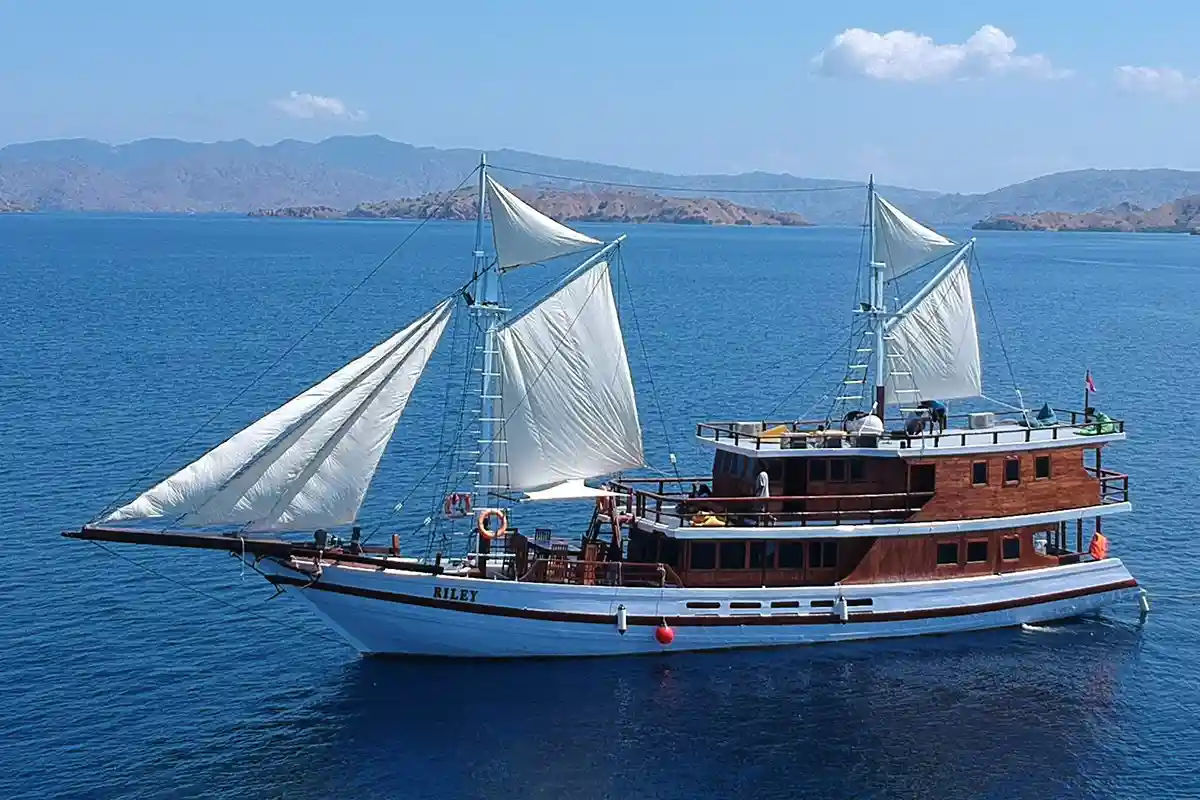
 Riley Phinisi Editorial Desk
In short: Riley Phinisi is a traditional Buginese phinisi schooner built in Bulukumba, South Sulawesi, in 2020, with a hull of ulin ironwood and teak. At 29 metres long by 5 metres wide, it is a heavy displacement boat: it pushes through water at 6-9 knots rather than slamming over it.
Most descriptions of a phinisi stop at heritage. Hand-built. Buginese. Centuries of tradition. All of that is accurate, and none of it is the reason a guest sleeps through the second night. The reason is physical. A hull made of dense tropical hardwood, 29 metres long and 5 metres wide, moving at 6 to 9 knots, behaves in a particular way, and that behaviour is what you feel in the cabin, at the dinner table and in the deck jacuzzi.
This article explains the vessel around the rooms. For the rooms themselves, the guide to Riley’s four ensuite cabins covers layout and sleeping arrangements. Every figure quoted below is published on the Riley Phinisi specifications page. Riley Phinisi is operated by Komodo Luxury.
A phinisi is a hull type, not a decoration
The phinisi is an Indonesian wooden schooner form associated with the Buginese and Konjo boatbuilders of South Sulawesi. The yards around Bulukumba, on the southern tip of the island, have built these hulls for generations, and they still build them the same way: heavy timber, shaped by eye and by hand, planked first and framed after, with the shape held in the builder’s judgement rather than in a printed set of lines.
Riley was built there in 2020. That date matters. It is a traditional hull form with contemporary systems inside it, not a converted antique. The construction method is old; the engine, generators, air conditioning and navigation equipment are not.
Ulin and teak do two different jobs
The hull uses ulin and teak, and they are not interchangeable.
Ulin, commonly called Bornean ironwood, is one of the densest commercially used timbers in Southeast Asia. It is heavy, extremely hard, and resistant to rot and marine borers in warm salt water, which is why it has been the structural timber of choice for Indonesian working boats for a very long time. It is also difficult to work, which is part of why hand-built hulls take as long as they do.
Teak carries natural oils that keep it dimensionally stable when it is soaked and then baked dry again, day after day. It does not swell and shrink as dramatically as most hardwoods, it holds fastenings well, and it stays grippy underfoot when wet.
The practical translation for a guest: a hull that is heavy for its length, and surfaces that stay stable through a tropical wet-dry cycle rather than warping and squeaking.
29 metres by 5 metres, and why that ratio matters
Riley measures 29 metres length overall on a 5-metre beam. That is a length-to-beam ratio of roughly 5.8 to 1 — long and comparatively narrow, not short and wide.
Two consequences follow. First, a long narrow hull parts water more efficiently at low speed, which is exactly the speed range a phinisi operates in. Second, weight and length together slow the motion down. A heavy 29-metre hull responds to a passing swell over a longer period than a light, beamy boat of half the length, which tends to snap back quickly. Slow motion is easier on the inner ear than fast motion, even when the total movement is similar.
The 6 to 9 knot cruising speed is part of the same picture. That is 11 to 17 km/h. At those speeds a heavy displacement hull moves through the water rather than climbing onto it and dropping off the back of waves, so there is no repeated slamming under the forward cabins.
What each specification changes onboard
| Specification | Riley Phinisi figure | What it changes onboard |
|---|---|---|
| Hull material | Ulin (ironwood) and teak | High density for the length; slower, longer roll period than a light hull |
| Length overall | 29 m | Deck and interior volume spread across a long waterline |
| Beam | 5 m | Length-to-beam roughly 5.8:1 — efficient at low speed |
| Year and place built | 2020, Bulukumba, South Sulawesi | Traditional Buginese build, modern systems fitted from new |
| Main engine | Mitsubishi 6D16 diesel | Single main diesel driving a low-speed displacement hull |
| Cruising speed | 6-9 knots (11-17 km/h) | Passage times between park anchorages; no planing, no slamming |
| Generators | 22 kVA + 30 kVA | Two units of different capacity to match load, plus redundancy |
| Fresh water | 5 tons (5,000 litres) | Supplies four ensuite bathrooms and the galley |
| Guest capacity | 4 cabins, all ensuite, max 10 guests | Deck and saloon space divided among 10 people at most |
| Navigation | Maritime GPS, VHF radio | Route planning and vessel-to-vessel contact in the park |
One main engine, two generators
The main engine is a Mitsubishi 6D16 diesel. It is not there to make the boat fast — 6 to 9 knots is the operating range — so it works at moderate load rather than being pushed, which is a quieter arrangement than a high-output engine near its limit.
The generators are listed as 22 kVA and 30 kVA. Two sets of different sizes let the crew match generation to actual demand instead of running one large unit at low load around the clock, and give a fallback if one needs attention. This matters because air conditioning in all four ensuite cabins is a continuous electrical load, not an occasional one.
Five tons of fresh water for ten guests
Fresh water capacity is 5 tons, or 5,000 litres. With a maximum of 10 guests, that is 500 litres per guest across a trip before crew and galley use is counted. On a three- or four-night charter through Komodo National Park, that is the difference between a rinse-and-be-quick regime and four ensuite bathrooms used normally after every snorkel stop.
The deck also carries the signature jacuzzi — a real water and weight load that a lightly built boat of this length would notice more than a heavy timber one does.
What wooden construction does not solve
Honesty is more useful than sales copy here. A heavy wooden hull damps motion; it does not eliminate it. Open crossings in the Flores Sea can be lively regardless of what the boat is made of, particularly on longer legs away from the sheltered water inside the park. If you are prone to motion sickness, hull material is a smaller factor than cabin position and timing, which is covered in the article on managing seasickness on board Riley.
Wood also demands continuous maintenance in the tropics in a way that fibreglass does not. That cost sits with the operator rather than the guest, but it is the honest trade behind the ride quality.
Seeing it in context
The construction argument only means something against a real route. Riley’s home port is Labuan Bajo, Flores, and the boat works inside Komodo National Park: Padar Island, Pink Beach, the dragon habitats on Komodo and Rinca, Manta Point, the sandbar at Taka Makassar, and the flying foxes at Kalong. Those hops are short at 6 to 9 knots, which is why a slow, heavy hull suits this cruising ground so well. The published Riley itinerary shows how the sailing blocks sit between stops, and the liveaboard overview explains how the vessel is used across a full charter.
Private charter is published at USD 3,350 per night for 2026 and USD 3,800 per night for 2027, with the full breakdown on the Riley pricing page. Availability and dates run through the Riley booking page.
To confirm dates, official booking is handled by Komodo Luxury, by WhatsApp at +62 811-3823-875, or by email at [email protected]. Full vessel details and route pages are on the official Riley Phinisi website.
Frequently asked questions
What is a phinisi made of, and does the material actually matter?
A phinisi is a wooden Indonesian schooner. Riley’s hull uses ulin, the ironwood of Borneo and Sulawesi, together with teak. The material matters because dense timber makes the boat heavy for its length, and weight slows the rate at which a hull rolls. A heavy 29-metre hull answers a passing wave more gently than a light one.
Is Riley Phinisi an antique boat or a new one?
It is a traditional design built recently. The vessel was built in 2020 in Bulukumba, South Sulawesi, using Buginese boatbuilding methods, and fitted with current systems: a Mitsubishi 6D16 main engine, 22 kVA and 30 kVA generators, maritime GPS and VHF radio, and air conditioning in all four ensuite cabins. Traditional hull, contemporary equipment.
Does a wooden hull feel less stable than steel or fibreglass?
Stability comes from hull shape, weight and loading rather than from the material label. Riley carries 29 metres of length on a 5-metre beam, a ratio of roughly 5.8 to 1, so it is long and comparatively narrow. That favours a slower, longer roll rather than the quick snap shorter and wider boats can produce in a beam sea.
How fast does Riley Phinisi move between Komodo anchorages?
Cruising speed is 6 to 9 knots, roughly 11 to 17 km/h. Stops inside Komodo National Park such as Padar Island, Pink Beach, Taka Makassar and Manta Point are close together at that pace. The published itinerary shows where the sailing blocks fall relative to each day’s activities, so you can see the actual time spent under way.
Why does the boat carry two generators?
The specifications list 22 kVA and 30 kVA. Two units of different capacity let the crew match generation to real demand instead of running a single large set continuously, and provide a fallback at anchor. Air conditioning across four ensuite cabins is the main continuous load. For operating detail on a specific date, ask Komodo Luxury directly.