
 Riley Phinisi Editorial Desk
In short: Chartering in Komodo National Park costs money in three places: government permits, boat operations, and local wages. Guests control the rest — reef contact, manta distance, water use against a 5-ton tank, waste sorting, and dragon-trail conduct. Riley Phinisi, operated by Komodo Luxury, runs 4 ensuite cabins for a maximum of 10 guests.
Most travellers meet conservation in Komodo as a line item on a booking confirmation: a permit here, an entry ticket there. That is the transactional half of the story, and we cover the mechanics of it in the guide to Komodo park fees and permits. This article is the other half — what the money actually pays for, and which decisions on board are yours rather than the park’s.
The honest framing matters because a phinisi charter is a large object moving through a fragile place. Riley Phinisi, the 29-metre schooner described across this site, was built in 2020 in Bulukumba, South Sulawesi, from ulin (ironwood) and teak, and operates in Komodo National Park from its home port in Labuan Bajo, Flores. It is operated by Komodo Luxury. Everything below is written from the specifications of that boat rather than from generic sustainability language.
Three places your charter money goes
Private charter rates are published: USD 3,350 per night for 2026 and USD 3,800 per night for 2027. Park permits are a separate matter, collected by the park authorities. Splitting the total this way makes it clear which levers a guest actually holds.
| Where the money goes | What it covers | What the guest influences |
|---|---|---|
| Park entry and activity permits | Ranger-managed access to Komodo and Rinca, and to the marine zones around Manta Point, Pink Beach and Taka Makassar | Booking the correct permit category for your dates and nationality; staying on ranger-guided trails instead of wandering |
| Vessel operation (part of the USD 3,350 / USD 3,800 per night rate) | Fuel for the Mitsubishi 6D16 main engine, generator hours, the 5 tons of fresh water, and upkeep of an ulin-and-teak hull | Air-conditioning and jacuzzi use, shower length, and how many extra tender runs you request |
| Crew wages and the Labuan Bajo supply chain | Provisioning, port services and employment anchored in Flores rather than offshore | Tipping practice, and asking that provisioning stay local where the menu allows |
None of this makes a charter carbon-neutral, and claiming otherwise would be dishonest. It does mean the difference between a well-run boat and a careless one is measurable in water, fuel, plastic and reef contact — four things you can see for yourself over three or four nights.
Five tons of fresh water is a real budget
The single most useful number for a guest is the water tank. Riley carries 5 tons of fresh water — roughly 5,000 litres — and there is no resupply until the boat returns to Labuan Bajo. That volume serves up to 10 guests plus crew, four ensuite bathrooms, the galley, deck rinses and the signature deck jacuzzi. The full equipment list sits on the Riley Phinisi specifications page.
| Onboard system | Verified spec | Why it is finite | Habit that helps |
|---|---|---|---|
| Fresh water | 5 tons (about 5,000 litres) | Shared by guests, crew, galley and jacuzzi for the whole cruise | Short showers; rinse snorkel gear in a bucket rather than under a running deck hose |
| Power | Generators 22 kVA + 30 kVA | Every kilowatt-hour at anchor comes from diesel | Keep cabin doors shut while the air conditioning runs; switch it off when you are on deck |
| Propulsion | Mitsubishi 6D16 diesel, cruising 6–9 knots | Passages between anchorages take hours, not minutes | Accept the planned route instead of asking for extra repositioning |
| Cabins | 4 cabins, all ensuite with air conditioning, maximum 10 guests | A hard guest cap limits how many people land at each site | Stagger snorkel entries so the group never crowds one patch of reef |
| Deck jacuzzi | Filled from the same 5-ton supply | A refill is water that cannot be used elsewhere | Treat it as a shared feature for the cruise, not an on-demand top-up |
A cruising speed of 6–9 knots also shapes the itinerary. Padar Island, Pink Beach, Komodo, Rinca, Manta Point, Taka Makassar and Kalong are sequenced around what the hull can comfortably cover, which is why the Riley itinerary reads as a loop rather than a shopping list. Requesting a site far off the route burns fuel for one photograph.
Reef and manta etiquette
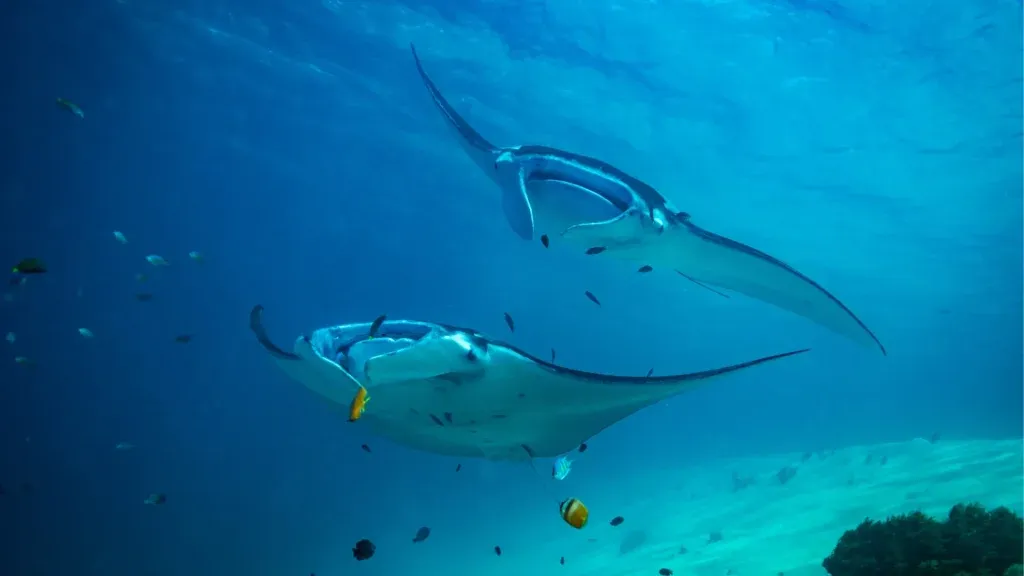
Manta Point and Taka Makassar are where guest behaviour has the most immediate effect. The rules are simple, and a good crew will brief them before anyone enters the water:
- Never touch, ride or chase a manta ray. Stay low in the water column, keep well to the side, and let the animal decide the distance.
- Do not block a cleaning station. Mantas queue at them; a swimmer parked overhead sends the whole line away.
- Keep fins horizontal and away from coral. Standing on or kicking a reef does damage that takes years to regrow.
- Wear a rash guard, or use mineral sunscreen, and apply it well before entering the water.
- Take no sand and no shells from Pink Beach or the Taka Makassar sandbar. Both are part of the park.
- Keep drones away from Kalong at dusk. The flying foxes leave the mangroves on a schedule that noise disrupts.
Snorkelling logistics, entry points and gear are covered separately in the post on snorkelling from Riley. The etiquette above applies to every site on the route.
Dragon-viewing conduct on Komodo and Rinca
Komodo dragons are wild animals on their own island, and access is ranger-controlled for a reason. Walk in one group, stay behind the ranger, and never split off for a better angle. Do not carry food or strongly scented items onto the trail. Do not feed, bait or provoke an animal for a photograph — that is the behaviour that ruins access for the guests behind you. Keep the group quiet, keep children within arm’s reach, and follow whatever the ranger says on the day, including advice about health conditions that make the walk unwise.
How to judge an operator on conservation grounds
If you are comparing boats, the useful questions are specific ones. Ask where grey water and galley waste go. Ask whether the boat carries refillable water for guests instead of case after case of single-use bottles. Ask how the boat anchors — sand patches and moorings rather than coral heads. Ask whether crew are hired from Flores. Ask whether the operator publishes its specifications and its rates in public, or only sends them on request. A boat that will not put its fresh-water capacity, engine and guest cap in writing is asking you to take its footprint on faith.
Guest caps matter more than any brochure claim. Four cabins and a maximum of 10 guests is a small number of people arriving at Padar or Pink Beach at once. Compare that against shared vessels on the same Komodo destinations before you decide what a low-impact trip looks like for your group.
Frequently asked questions
Are Komodo National Park conservation fees included in the charter rate?
The published private charter rate is USD 3,350 per night for 2026 and USD 3,800 per night for 2027. Park permits are administered separately by the park authorities, and the categories change with nationality and activity. Confirm exactly what is included for your dates with Komodo Luxury before you pay a deposit, not after.
How much fresh water is available on board?
Riley carries 5 tons of fresh water, roughly 5,000 litres, and that supply serves up to 10 guests plus crew, four ensuite bathrooms, the galley and the deck jacuzzi for the whole cruise. There is no resupply between Labuan Bajo departures, so short showers make a genuine difference by the final night.
What is the correct behaviour around manta rays?
Keep a wide berth, stay low and horizontal, and never touch, chase or swim directly above a manta. Avoid parking over cleaning stations, since that pushes the animals away from the site entirely. Let the ray choose the distance and it will often pass closer than any pursuit would achieve.
Does a smaller boat really reduce impact?
Partly. A maximum of 10 guests across 4 cabins limits how many people step onto a trail or enter the water at one anchorage, which reduces crowding at sensitive sites. It does not eliminate fuel use or waste. The honest answer is that group size is one variable among several, and operating discipline matters as much.
Can I bring my own reusable bottle and reef-safe sunscreen?
Yes, and both are worth packing. A reusable bottle cuts single-use plastic on a four-day cruise, and mineral sunscreen or a rash guard reduces what washes off you at Manta Point and Taka Makassar. Apply sunscreen well before entering the water so it has time to bind.
Planning a charter on these terms
If conservation conduct is part of how you are choosing a boat, raise it during the enquiry rather than on embarkation day. Rates and season windows are set out on the charter pricing page, and the process itself is explained under Riley Phinisi booking.
Official availability and confirmed quotations for Riley Phinisi come through Komodo Luxury, the operator of the boat. Reach the reservations team on WhatsApp at +62 811-3823-875 or by email at [email protected] with your dates, group size and any questions about permits, water, or conduct at the sites you want to visit.