
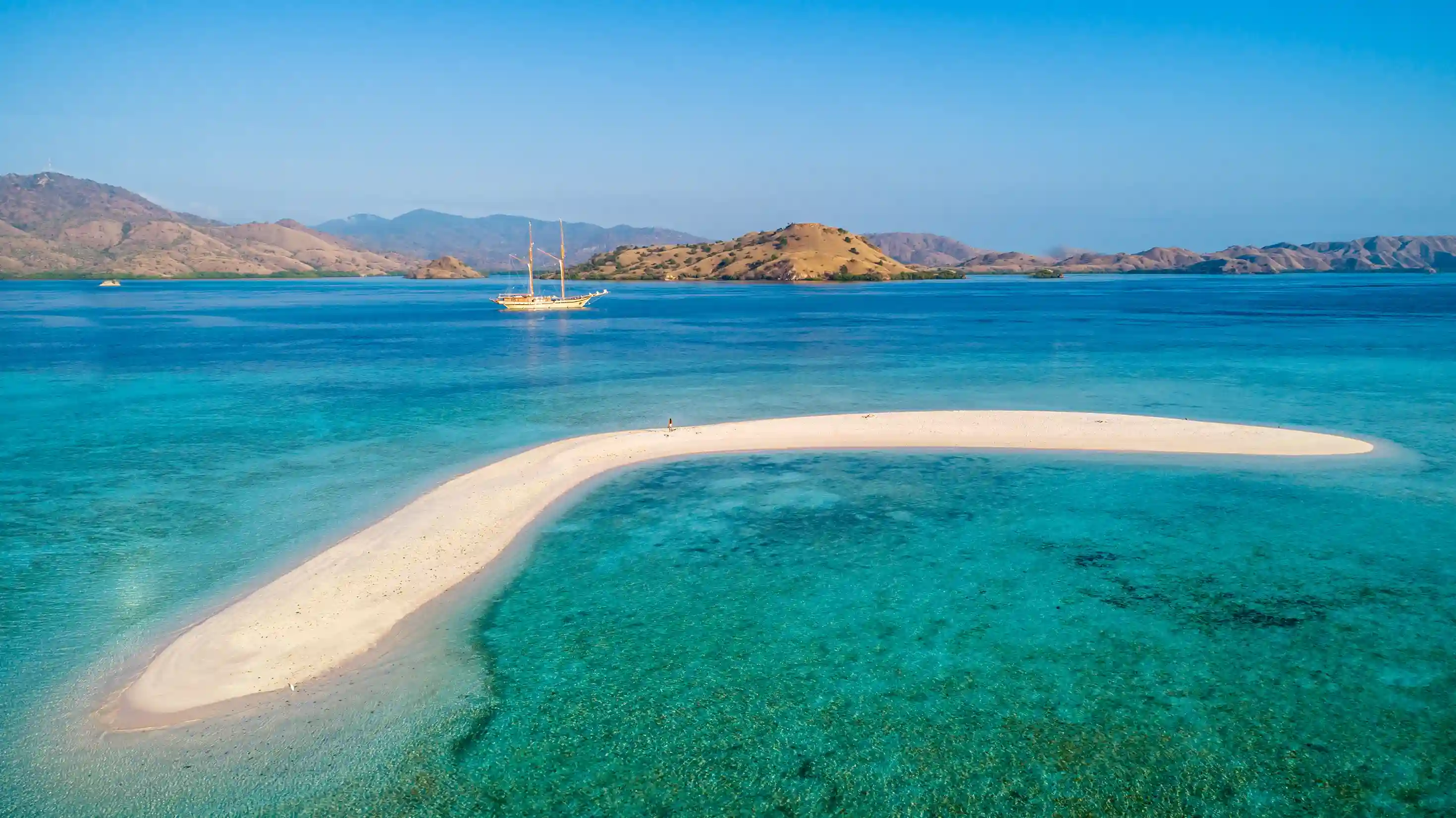
 Riley Phinisi Editorial Desk
In short: Mobile data is reliable around Labuan Bajo and thins out fast at the outer anchorages of Komodo National Park. Riley Phinisi’s published navigation equipment — maritime GPS and VHF radio — is safety gear, not guest internet. Plan for hours offline, and confirm connectivity in writing with Komodo Luxury before booking.
Two kinds of guests ask about connectivity before they pay a charter deposit: the person with a client call that cannot be moved, and the parent leaving a teenager, an elderly relative or a business behind. Both deserve a straight answer instead of a brochure line about staying connected.
Here is the honest version. The official Riley Phinisi charter site describes a 29-metre traditional Buginese phinisi schooner, built in 2020 in Bulukumba, South Sulawesi, with an ulin ironwood and teak hull, four ensuite cabins for a maximum of ten guests, and a signature deck jacuzzi. Riley Phinisi is operated by Komodo Luxury. Its published communication and navigation equipment is maritime GPS and VHF radio — equipment for the bridge, not a guest hotspot. Mobile coverage inside the park comes from Indonesian cellular networks, not from the vessel, and it weakens the further you travel from Labuan Bajo.
What the published equipment covers, and what it does not
Reading the full Riley Phinisi specifications with connectivity in mind is useful, because several published numbers change how you should plan your days offline.
| Published specification | What it means for staying reachable |
|---|---|
| Navigation: maritime GPS, VHF radio | Vessel safety and vessel-to-vessel or vessel-to-shore communication handled by the crew. Not a guest internet service and not a phone line home. |
| Generators 22 kVA + 30 kVA | Power for air conditioning in all four cabins and for charging devices. On a Komodo charter, power is rarely the constraint — cellular coverage is. |
| Main engine Mitsubishi 6D16, cruising speed 6–9 knots | Repositioning toward the town side of the park to chase signal costs hours, not minutes. Build that into any promise you make to the office. |
| 4 cabins, maximum 10 guests | A small group sharing identical conditions. If one person tethers a phone, everyone else is competing for the same thin bandwidth. |
| Home port Labuan Bajo, Flores | The strongest and most predictable signal of the whole trip is at the start and the end, in and around the harbour. |
| Private charter USD 3,350/night (2026), USD 3,800/night (2027) | You control the schedule. A private charter can be routed to keep a signal window on a specific morning if you ask before departure. |
How signal behaves between Labuan Bajo and the outer anchorages
Coverage in eastern Indonesia is built around towns and airports. Labuan Bajo has both. The islands do not. As a rule, the usable signal follows the town, and once the boat is past the first headlands the connection becomes a matter of luck, carrier, handset and where you happen to be standing on deck.
Treat the table below as a planning assumption, not a coverage guarantee. Nobody — including an operator — can promise a specific bar count at a specific anchorage on a specific afternoon.
| Point in the itinerary | Plan for | What to do there |
|---|---|---|
| Labuan Bajo harbour, before departure | Usable data and calls | Final calls, file uploads, downloads, message the people who worry. |
| Passage toward Komodo and Rinca | Intermittent, text-only at best | Send short messages, not attachments. Expect drops mid-sentence. |
| Padar Island anchorage | Weak to none | Assume offline. Photograph the ridgeline, upload later. |
| Pink Beach, Taka Makassar, Manta Point | None | Full offline block. This is the core of the trip. |
| Kalong, at sunset for the flying foxes | None to very weak | Nobody wants a phone out here anyway. |
| Return leg to Labuan Bajo | Signal returns near town | Catch-up window: replies, confirmations, onward flight check-in. |
Questions to confirm with the operator before you book
If your trip genuinely depends on being reachable, put these in writing to Komodo Luxury and keep the reply. A verbal yes on a busy day is not a plan.
- Is any onboard internet available on my specific dates, and if so, on what terms and with what realistic limits?
- Which Indonesian carrier does the crew use, and which one do they recommend for guests?
- Is there a point in my chosen route where the boat predictably regains signal, and roughly when?
- What is the emergency communication chain — how does the crew reach the office ashore, and how does the office reach me?
- Can the route be adjusted mid-trip to reach a signal area if something urgent comes up at home, and what does that cost in sailing hours?
- Who ashore is my family’s single point of contact during the charter, and on which number?
A working offline plan for the days on board
The guests who cope best are the ones who prepared in Labuan Bajo rather than hoping at Pink Beach.
- Buy and activate an Indonesian SIM or eSIM before you board, not after. Activation itself needs signal.
- Download offline maps, boarding passes, hotel confirmations, e-books, films and music while you still have town data.
- Set an out-of-office and a WhatsApp status that name your return date. Silence is what makes people panic.
- Agree fixed check-in windows with home — for example, departure morning and return afternoon — rather than promising daily contact.
- Bring a power bank and a waterproof pouch. Charging is fine on board; a soaked phone at an outer Komodo anchorage is not recoverable.
- Carry a printed copy of the itinerary and the operator’s contact details for whoever stays at home.
If someone at home needs to reach you
The realistic channel is the operator, not your handset. Give your family the Komodo Luxury office contacts before departure and explain that a message left there will reach the boat through the crew’s own communication routine. The VHF radio listed in the specifications is a maritime safety channel operated by the crew, not a guest telephone — that distinction matters, and it is exactly why the shore-side contact protocol needs agreeing in advance. Guests travelling with children or elderly relatives should read the general Komodo safety guidance alongside this page.
Remote work on a 3D2N or 4D3N charter
A short charter is a poor place to hold a live meeting and a good place to do offline work: reading, writing, reviewing documents you downloaded in town. Look at the day-by-day itinerary and mark which blocks are realistically offline, then move any hard deadline outside the charter window. At the published private charter rates, spending the trip hunting for bars on the top deck is an expensive way to be half-present. Packing decisions matter too — the Komodo packing list covers the dry bags and power gear that keep devices alive.
Frequently asked questions
Does Riley Phinisi have wifi on board?
Riley Phinisi’s published specifications list maritime GPS and VHF radio as its navigation and communication equipment. Guest internet is not part of that published list, so any onboard connectivity arrangement should be confirmed directly with Komodo Luxury for your specific dates before you book, rather than assumed from third-party listings.
Will my phone work inside Komodo National Park?
Expect a usable signal in and around Labuan Bajo, patchy coverage on passages, and long stretches with nothing at the outer anchorages such as Pink Beach, Taka Makassar and Manta Point. Coverage varies by carrier, handset and weather. Plan every commitment on the assumption that you are offline once the boat leaves town.
Can I work remotely during a Komodo charter?
Offline work is realistic; live video calls are not. Download what you need before departure, schedule deadlines outside the charter window, and treat the return leg toward Labuan Bajo as your catch-up window. A private charter gives you some scheduling flexibility, but sailing at 6–9 knots means repositioning for signal costs hours.
How can my family reach me in an emergency?
Through the operator ashore. Before departure, give your family the Komodo Luxury office contacts and your exact charter dates, and ask the operator to confirm how a message reaches the vessel. Agree check-in windows at the start and end of the trip so that expected silence in between is not mistaken for a problem.
Should I buy an Indonesian SIM before the trip?
Yes. A local SIM or eSIM generally performs better across eastern Indonesia than international roaming, and it is cheaper. Buy and activate it in Bali or Labuan Bajo, where there is signal to complete registration. Even with the best local carrier, plan for hours with no data at the outer anchorages.
Booking and confirming your dates
Availability, current-season connectivity arrangements and route adjustments are all handled by the operator. Book officially through Komodo Luxury, message WhatsApp +62 811-3823-875, or email [email protected]. Charter rates are USD 3,350 per night for 2026 and USD 3,800 per night for 2027 on a private basis. For the practical steps and documents involved, see the Riley Phinisi booking page, and check the charter FAQ for anything this article did not answer.