
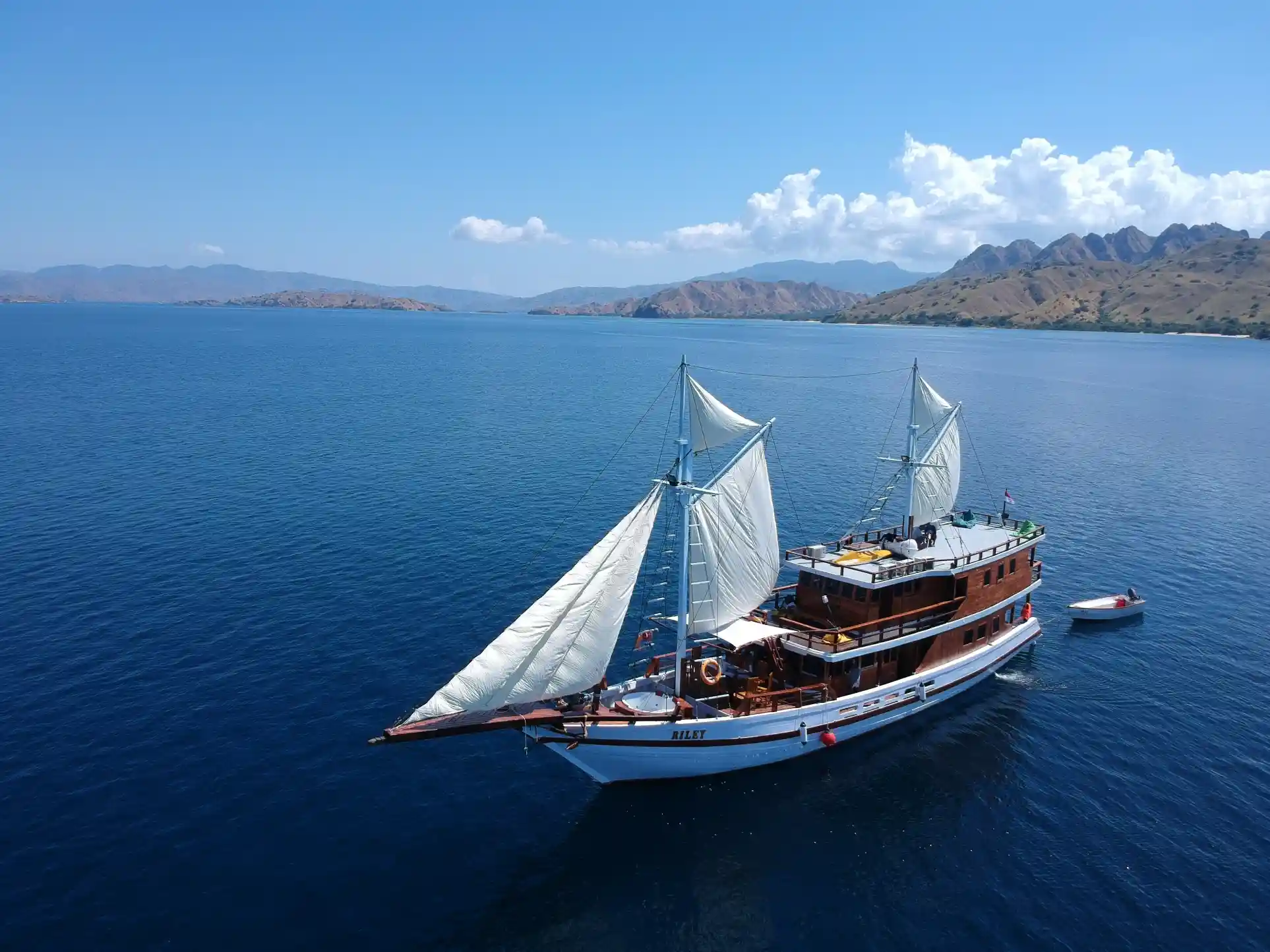
 Riley Phinisi Editorial Desk
In short: In Komodo, a wooden phinisi gives the most usable deck space and the slowest, steadiest rhythm; a catamaran gives the flattest platform at anchor; a fibreglass motor yacht gives speed between islands. Riley Phinisi is a 29 m Buginese schooner cruising 6-9 knots with four ensuite cabins for up to 10 guests.
Most people planning a Komodo charter start by comparing boat names. That is the second decision. The first is hull type, because a phinisi, a catamaran and a fibreglass motor yacht produce three genuinely different trips out of the same islands and the same four days. This guide stays at category level so you can settle the hull question first.
Three hulls, three different days on the water
A phinisi is a traditional Indonesian wooden schooner from Bulukumba in South Sulawesi, where Buginese shipwrights have built cargo and passenger schooners for generations. Modern charter phinisi keep the deep, heavy displacement hull, then fit it out with cabins, air conditioning and generators. Riley Phinisi was built this way in 2020, with an ulin (ironwood) and teak hull.
A catamaran is a twin-hulled boat, usually fibreglass, with a bridgedeck saloon spanning the hulls and cabins set inside them. A fibreglass motor yacht is a single-hulled powerboat built for transit speed, with interior-focused living space and larger engines.
None of these is objectively better. They trade the same three things against each other: deck space, motion, and speed.
Deck space is where a Komodo trip actually happens
In Komodo you spend very little time indoors. The day is sunrise on Padar, a dragon walk on Komodo or Rinca, snorkelling at Manta Point or Taka Makassar, then flying foxes at Kalong after dark. Between those, everyone is on deck.
This is where the phinisi hull is hard to beat. A 29 m length with a 5 m beam gives long, uninterrupted deck runs on several levels: a foredeck for sunrise, a shaded main deck for meals, an upper deck for the sundowner hour. Riley’s deck jacuzzi sits in that outdoor space rather than competing with it.
A catamaran answers differently. Its deck area is wide rather than long, and the trampolines between the bows are the signature spot — sociable, but concentrated. A motor yacht typically puts its best space inside: an air-conditioned saloon, a flybridge, less shaded open deck per guest. If your group wants to be indoors between stops, that is a feature, not a fault.
Motion at anchor and under way
This is the difference guests feel most and research least.
A catamaran resists roll because two widely spaced hulls have to lift and drop together. At anchor in a beam swell it stays flat; under way it can develop a quicker, snappier motion.
A displacement phinisi behaves the opposite way. It is heavy, deep and slow to react, so it produces a long, gentle roll instead of a sharp one. Komodo’s overnight anchorages are mostly sheltered, and that slow period is what many guests describe as easy to sleep through. If motion sickness is your main concern, read our notes on managing seasickness on a Komodo liveaboard before choosing.
A planing motor yacht is the least predictable of the three: fast and dry in flat water, but at anchor a narrow single hull with high freeboard can roll noticeably unless stabilisers are fitted.
Speed: why 6-9 knots is a design choice
Riley runs a Mitsubishi 6D16 diesel and cruises at 6-9 knots. In Komodo National Park that is the normal working speed for the route: anchorages sit close together, and most repositioning happens overnight or during meals. A faster hull does not add a stop to a 3D2N itinerary — it arrives earlier and waits.
What speed changes is the texture of the trip. At 7 knots you watch the islands arrive. Our day-by-day Komodo itinerary is built around that slower rhythm, with long stops rather than long transits.
Side by side: how the three hull types compare
| Criterion | Wooden phinisi (e.g. Riley, 29 m) | Catamaran | Fibreglass motor yacht |
|---|---|---|---|
| Cruising speed | 6-9 knots (Riley, Mitsubishi 6D16) | Typically moderate; sail-dependent | Typically the fastest of the three |
| Open deck space per guest | Highest — multiple full-length decks | Wide but concentrated (trampolines, bridgedeck) | Lowest — space weighted to interiors |
| Motion at anchor | Slow, long roll from a heavy displacement hull | Flattest; twin hulls resist roll | Varies; can roll without stabilisers |
| Cabin feel | Full-beam-style wooden cabins; Riley has 4, all ensuite with AC | Narrow cabins inside the hulls | Compact, hotel-style interiors |
| Guest capacity style | Small-group private charter (Riley: max 10) | Small group | Varies widely |
| Character | Traditional Indonesian build; local craft heritage | Modern, technical, minimal | Contemporary, hotel-like |
Riley’s verified numbers, for the phinisi column
A category comparison only helps if one column is real. These are Riley’s published figures, listed in full on the Riley Phinisi specifications page.
| Specification | Riley Phinisi |
|---|---|
| Type | Traditional Buginese phinisi schooner |
| Length overall / beam | 29 m / 5 m |
| Built | 2020, Bulukumba, South Sulawesi |
| Hull material | Ulin (ironwood) and teak |
| Cabins | 4, all ensuite with air conditioning |
| Maximum guests | 10 |
| Main engine | Mitsubishi 6D16 diesel, 6-9 knots cruising |
| Generators | 22 kVA + 30 kVA |
| Fresh water | 5 tons |
| Navigation | Maritime GPS, VHF radio |
| Home port | Labuan Bajo, Flores |
| Private charter rate | USD 3,350/night (2026) · USD 3,800/night (2027) |
Which hull suits which trip
- Choose a catamaran if flat motion is the single most important factor and you are happy with a more compact, modern feel.
- Choose a motor yacht if you want to cover long distances quickly, or your group prefers air-conditioned interiors over shaded deck time.
- Choose a phinisi if the deck is the point of the trip: sunrise coffee before Padar, long lunches under shade, snorkel gear left where you dropped it, and a slow passage between islands rather than a sprint.
Capacity matters too. Ten guests on a 29 m hull is low density, which is why private phinisi charters read differently from a berth-by-berth trip — a distinction we cover in our comparison of a private charter versus a shared Komodo liveaboard. The full route list is on the Komodo destinations page.
Where Riley sits on the category map
Riley Phinisi, the traditional Komodo schooner, sits firmly in the phinisi column. It is a 2020 ironwood-and-teak build from Bulukumba, homeported in Labuan Bajo, working the same park anchorages as every other hull type — Padar, Pink Beach, Komodo and Rinca, Manta Point, Taka Makassar and Kalong. What it offers is the phinisi trade: deck space and a slow, heavy passage, with four ensuite air-conditioned cabins, 22 kVA and 30 kVA generators and 5 tons of fresh water behind the traditional exterior. Riley is operated by Komodo Luxury; nightly rates are on the Riley charter pricing page.
Frequently asked questions
Is a phinisi or a catamaran more stable at anchor in Komodo?
A catamaran is flatter, because two widely spaced hulls resist rolling. A heavy wooden phinisi rolls more, but far more slowly — a long, gentle period rather than a sharp one. Most guests find the slow motion easier to sleep through, and Komodo’s overnight anchorages are generally sheltered, which narrows the practical gap considerably.
How fast does a phinisi cruise compared with a motor yacht?
Riley cruises at 6-9 knots on its Mitsubishi 6D16 diesel, which is normal for a displacement phinisi. A planing motor yacht is faster. In Komodo National Park this rarely changes the itinerary, because anchorages sit close together and most repositioning happens overnight or during meals rather than in guest time.
Which hull type works best for a group of ten?
A 29 m phinisi handles ten guests comfortably because deck area, not cabin count, is the limiting factor on a Komodo trip. Riley carries a maximum of 10 guests across four ensuite air-conditioned cabins. Catamarans of similar guest capacity concentrate people into fewer social spaces, which some groups prefer and others do not.
Does a wooden hull mean fewer modern comforts?
No. The build method is traditional; the systems are not. Riley pairs an ulin and teak hull with 22 kVA and 30 kVA generators, 5 tons of fresh water, air conditioning in all four ensuite cabins, a deck jacuzzi, and maritime GPS with VHF radio. The wood affects how the boat moves and feels, not what it can run.
What does a private phinisi charter in Komodo cost?
Riley’s published private charter rate is USD 3,350 per night for 2026 and USD 3,800 per night for 2027, for the whole vessel rather than per person. Because the boat takes a maximum of ten guests, the per-person figure depends entirely on group size. Availability and inclusions are confirmed at booking.
Checking dates
If the phinisi column is the one that matches your trip, availability for Riley is handled by its operator. Book officially through Komodo Luxury, message WhatsApp +62 811-3823-875, or email [email protected]. Rates, cabin allocation and route options are set out on the Riley booking page.